Model Gallery

72 models from 1 repositories

Filter by type:

Filter by tags:

ornith-1.0-9b
[](https://deep-reinforce.com/ornith.html) # Ornith-1.0-9B-GGUF Aloha! 🌺 Today, we are releasing Ornith-1.0, a self-improving family of open-source models for agentic coding. Highlights: - **State-of-the-Art Coding Agents**: Available in 9B-Dense, 31B-Dense, 35B-MoE, and 397B-MoE (post-trained on top of Gemma 4 and Qwen 3.5), achieving state-of-the-art performance among open-source models of comparable size on coding benchmarks such as Terminal-Bench 2.1, SWE-Bench, NL2Repo and OpenClaw. - **Self-Improving Training Framework**:  Ornith-1.0 employs RL to learn to generate not only solution rollouts, but also the scallfold that drive those rollouts. By jointly optimizing the scaffold and the resulting solution, the model discovers better search trajectories and generates higher-quality solutions. - **Licence**: MIT licensed, globally accessible, and free from regional limitations. ## Ornith 1.0 9B This model card documents **Ornith-1.0-9B**, the most lightweight member of the Ornith family, designed for efficient single-GPU deployment. ### Benchmarks Ornith-1.0-9B Qwen3.5-9B Qwen3.5-35B Gemma4-12B Gemma4-31B Agentic Coding ...

Repository: localaiLicense: mit

ornith-1.0-35b
[](https://deep-reinforce.com/ornith.html) # Ornith-1.0-35B-GGUF Aloha! 🌺 Today, we are releasing Ornith-1.0, a self-improving family of open-source models for agentic coding. Highlights: - **State-of-the-Art Coding Agents**: Available in 9B-Dense, 31B-Dense, 35B-MoE, and 397B-MoE (post-trained on top of Gemma 4 and Qwen 3.5), achieving state-of-the-art performance among open-source models of comparable size on coding benchmarks such as Terminal-Bench 2.1, SWE-Bench, NL2Repo and OpenClaw. - **Self-Improving Training Framework**: Ornith-1.0 employs RL to learn to generate not only solution rollouts, but also the scallfold that drive those rollouts. By jointly optimizing the scaffold and the resulting solution, the model discovers better search trajectories and generates higher-quality solutions. - **Licence**: MIT licensed, globally accessible, and free from regional limitations. ## Ornith 1.0 35B This model card documents **Ornith-1.0-35B**, the lightweight member of the Ornith family, designed for efficient single-GPU deployment. ### Benchmarks Ornith-1.0-35B Qwen3.5-35B Qwen3.6-35B Gemma4-31B Qwen3.5-397B Agentic Coding ...

Repository: localaiLicense: mit

glm-5.2
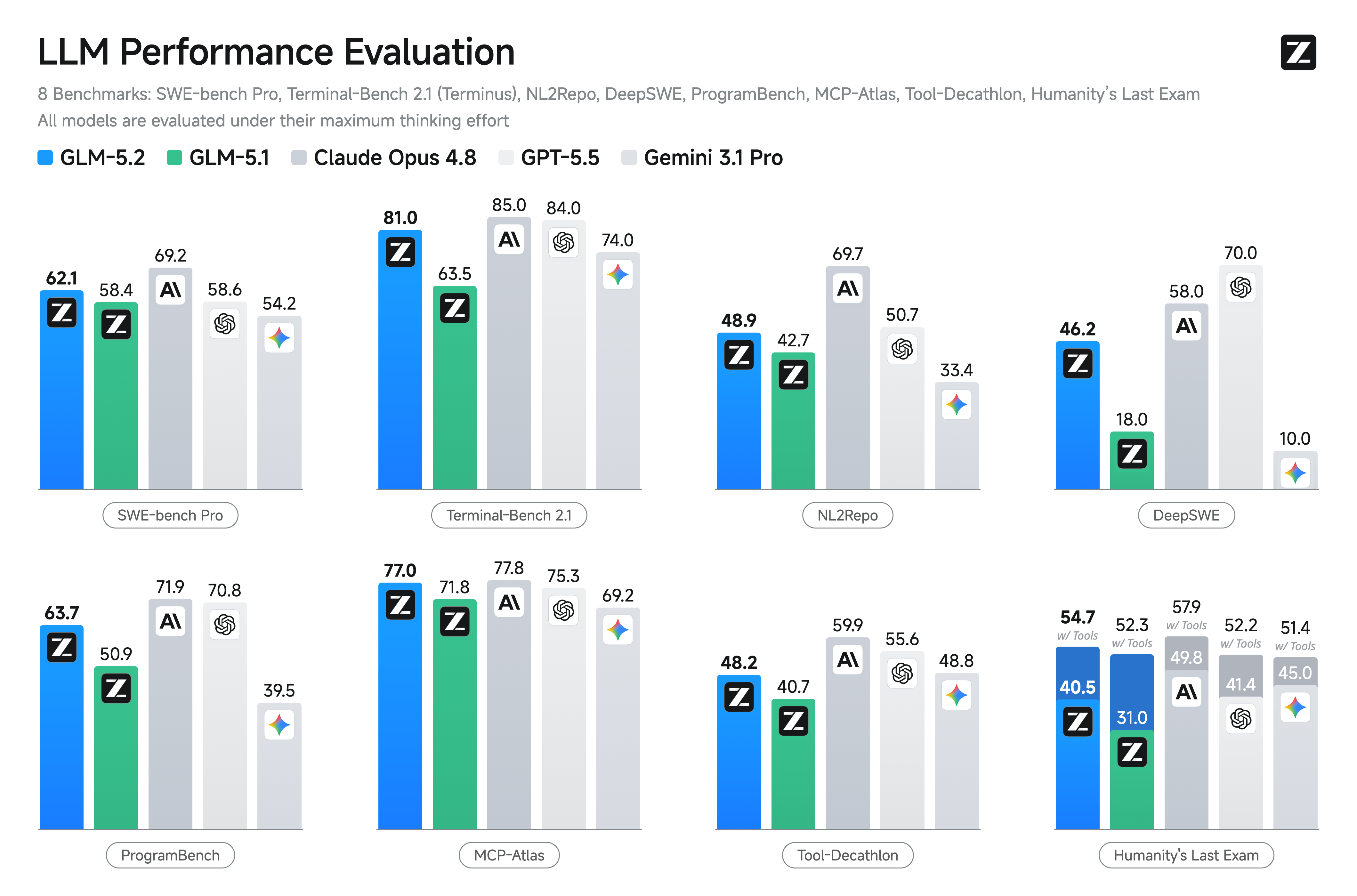
# GLM-5.2 👋 Join our WeChat or Discord community. 📖 Check out the GLM-5.2 blog and GLM-5 Technical report. 📍 Use GLM-5.2 API services on Z.ai API Platform. 🔜 Try GLM-5.2 here. [Paper] [GitHub] ## Introduction We're introducing GLM-5.2, our latest flagship model for long-horizon tasks. It marks a substantial leap in long-horizon task capability over its predecessor GLM-5.1 and, for the first time, delivers that capability on a **solid 1M-token context**. GLM-5.2's new capabilities include: - **Solid 1M Context:** A solid 1M-token context that stably sustains long-horizon work - **Advanced Coding with Flexible Effort**: Stronger coding capabilities with multiple thinking effort levels to balance performance and latency - **Improved Architecture**: We propose IndexShare, which reuses the same indexer across every four sparse attention layers, reducing per-token FLOPs by 2.9× at a 1M context length. We also improve GLM-5.2’s MTP layer for speculative decoding, increasing the acceptance length by up to 20% - **Pure Open**: An MIT open-source license — no regional limits, technical access without borders ## Benchmark ## Serve GLM-5.2 Locally ...

Repository: localaiLicense: mit

kimi-k2.6
🤗  huggingchat  |  📰  Tech Blog ## 1. Model Introduction Kimi K2.6 is an open-source, native multimodal agentic model that advances practical capabilities in long-horizon coding, coding-driven design, proactive autonomous execution, and swarm-based task orchestration. ### Key Features - **Long-Horizon Coding**: K2.6 achieves significant improvements on complex, end-to-end coding tasks, generalizing robustly across programming languages (Rust, Go, Python) and domains spanning front-end, DevOps, and performance optimization. - **Coding-Driven Design**: K2.6 is capable of transforming simple prompts and visual inputs into production-ready interfaces and lightweight full-stack workflows, generating structured layouts, interactive elements, and rich animations with deliberate aesthetic precision. - **Elevated Agent Swarm**: Scaling horizontally to 300 sub-agents executing 4,000 coordinated steps, K2.6 can dynamically decompose tasks into parallel, domain-specialized subtasks, delivering end-to-end outputs from documents to websites to spreadsheets in a single autonomous run. - **Proactive & Open Orchestration**: For autonomous tasks, K2.6 demonstra ...

Repository: localaiLicense: modified-mit

gemma-4-26b-a4b-it
Google Gemma 4 26B-A4B-IT is an open-source multimodal Mixture-of-Experts model with 26B total parameters and 4B active parameters. It handles text and image input, generating text output, with a 256K context window and support for 140+ languages. The MoE architecture provides strong performance with efficient inference. Well-suited for question answering, summarization, reasoning, and image understanding tasks.

Repository: localaiLicense: apache-2.0

gemma-4-e2b-it
Google Gemma 4 E2B-IT is a lightweight open-source multimodal model with 5B total parameters and 2B effective parameters using selective parameter activation. It handles text and image input, generating text output, with a 256K context window and support for 140+ languages. Optimized for efficient execution on low-resource devices including mobile and laptops.

Repository: localaiLicense: apache-2.0

gemma-4-e4b-it
Google Gemma 4 E4B-IT is an open-source multimodal model with 8B total parameters and 4B effective parameters using selective parameter activation. It handles text and image input, generating text output, with a 256K context window and support for 140+ languages. Offers a good balance of performance and efficiency for deployment on consumer hardware.

Repository: localaiLicense: apache-2.0

nanbeige4.1-3b-q8
Nanbeige4.1-3B is built upon Nanbeige4-3B-Base and represents an enhanced iteration of our previous reasoning model, Nanbeige4-3B-Thinking-2511, achieved through further post-training optimization with supervised fine-tuning (SFT) and reinforcement learning (RL). As a highly competitive open-source model at a small parameter scale, Nanbeige4.1-3B illustrates that compact models can simultaneously achieve robust reasoning, preference alignment, and effective agentic behaviors. Key features: Strong Reasoning: Capable of solving complex, multi-step problems through sustained and coherent reasoning within a single forward pass, reliably producing correct answers on benchmarks like LiveCodeBench-Pro, IMO-Answer-Bench, and AIME 2026 I. Robust Preference Alignment: Outperforms same-scale models (e.g., Qwen3-4B-2507, Nanbeige4-3B-2511) and larger models (e.g., Qwen3-30B-A3B, Qwen3-32B) on Arena-Hard-v2 and Multi-Challenge. Agentic Capability: First general small model to natively support deep-search tasks and sustain complex problem-solving with >500 rounds of tool invocations; excels in benchmarks like xBench-DeepSearch (75), Browse-Comp (39), and others.

Repository: localaiLicense: apache-2.0

nanbeige4.1-3b-q4
Nanbeige4.1-3B is built upon Nanbeige4-3B-Base and represents an enhanced iteration of our previous reasoning model, Nanbeige4-3B-Thinking-2511, achieved through further post-training optimization with supervised fine-tuning (SFT) and reinforcement learning (RL). As a highly competitive open-source model at a small parameter scale, Nanbeige4.1-3B illustrates that compact models can simultaneously achieve robust reasoning, preference alignment, and effective agentic behaviors. Key features: Strong Reasoning: Capable of solving complex, multi-step problems through sustained and coherent reasoning within a single forward pass, reliably producing correct answers on benchmarks like LiveCodeBench-Pro, IMO-Answer-Bench, and AIME 2026 I. Robust Preference Alignment: Outperforms same-scale models (e.g., Qwen3-4B-2507, Nanbeige4-3B-2511) and larger models (e.g., Qwen3-30B-A3B, Qwen3-32B) on Arena-Hard-v2 and Multi-Challenge. Agentic Capability: First general small model to natively support deep-search tasks and sustain complex problem-solving with >500 rounds of tool invocations; excels in benchmarks like xBench-DeepSearch (75), Browse-Comp (39), and others.

Repository: localaiLicense: apache-2.0

qwen3-vl-embedding-8b
**Model Name:** Qwen3-VL-Embedding-8B **Base Model:** Qwen/Qwen3-VL-8B-Instruct **Description:** The **Qwen3-VL-Embedding** and **Qwen3-VL-Reranker** model series are the latest additions to the Qwen family, built upon the recently open-sourced and powerful Qwen3-VL foundation model. Specifically designed for multimodal information retrieval and cross-modal understanding, this suite accepts diverse inputs including text, images, screenshots, and videos, as well as inputs containing a mixture of these modalities. **Key Features:** - Model Type: MultiModal Embedding - Supported Languages: 30+ Languages - Supported Input Modalities: Text, images, screenshots, videos, and arbitrary multimodal combinations (e.g., text + image, text + video) - Number of Parameters: 8B - Context Length: 32k - Embedding Dimension: Up to 4096, supports user-defined output dimensions ranging from 64 to 4096 **Downloads:** - [GGUF Files](https://huggingface.co/Qwen/Qwen3-VL-Embedding-8B) (e.g., `Qwen3-VL-Embedding-8B-Q8_0.gguf`). **Usage:** - Requires `transformers`, `qwen-vl-utils`, and `torch`. - Example: `from scripts.qwen3_vl_embedding import Qwen3VLEmbedder model = Qwen3VLEmbedder(...)` **Citation:** @article{qwen3vlembedding, ...} This description emphasizes its capabilities, efficiency, and versatility for multimodal search tasks.

Repository: localaiLicense: apache-2.0

qwen3-vl-embedding-2b
**Model Name:** Qwen3-VL-Embedding-2B **Base Model:** Qwen/Qwen3-VL-2B-Instruct **Description:** The **Qwen3-VL-Embedding** and **Qwen3-VL-Reranker** model series are the latest additions to the Qwen family, built upon the recently open-sourced and powerful Qwen3-VL foundation model. Specifically designed for multimodal information retrieval and cross-modal understanding, this suite accepts diverse inputs including text, images, screenshots, and videos, as well as inputs containing a mixture of these modalities. **Key Features:** - Model Type: MultiModal Embedding - Supported Languages: 30+ Languages - Supported Input Modalities: Text, images, screenshots, videos, and arbitrary multimodal combinations (e.g., text + image, text + video) - Number of Parameters: 2B - Context Length: 32k - Embedding Dimension: Up to 2048, supports user-defined output dimensions ranging from 64 to 2048 **Downloads:** - [GGUF Files](https://huggingface.co/Qwen/Qwen3-VL-Embedding-2B) (e.g., `Qwen3-VL-Embedding-2B-Q8_0.gguf`). **Usage:** - Requires `transformers`, `qwen-vl-utils`, and `torch`. - Example: `from scripts.qwen3_vl_embedding import Qwen3VLEmbedder model = Qwen3VLEmbedder(...)` **Citation:** @article{qwen3vlembedding, ...} This description emphasizes its capabilities, efficiency, and versatility for multimodal search tasks.

Repository: localaiLicense: apache-2.0

opengvlab_internvl3_5-30b-a3b
We introduce InternVL3.5, a new family of open-source multimodal models that significantly advances versatility, reasoning capability, and inference efficiency along the InternVL series. A key innovation is the Cascade Reinforcement Learning (Cascade RL) framework, which enhances reasoning through a two-stage process: offline RL for stable convergence and online RL for refined alignment. This coarse-to-fine training strategy leads to substantial improvements on downstream reasoning tasks, e.g., MMMU and MathVista. To optimize efficiency, we propose a Visual Resolution Router (ViR) that dynamically adjusts the resolution of visual tokens without compromising performance. Coupled with ViR, our Decoupled Vision-Language Deployment (DvD) strategy separates the vision encoder and language model across different GPUs, effectively balancing computational load. These contributions collectively enable InternVL3.5 to achieve up to a +16.0% gain in overall reasoning performance and a 4.05 ×\times× inference speedup compared to its predecessor, i.e., InternVL3. In addition, InternVL3.5 supports novel capabilities such as GUI interaction and embodied agency. Notably, our largest model, i.e., InternVL3.5-241B-A28B, attains state-of-the-art results among open-source MLLMs across general multimodal, reasoning, text, and agentic tasks—narrowing the performance gap with leading commercial models like GPT-5. All models and code are publicly released.

Repository: localaiLicense: apache-2.0

opengvlab_internvl3_5-30b-a3b-q8_0
We introduce InternVL3.5, a new family of open-source multimodal models that significantly advances versatility, reasoning capability, and inference efficiency along the InternVL series. A key innovation is the Cascade Reinforcement Learning (Cascade RL) framework, which enhances reasoning through a two-stage process: offline RL for stable convergence and online RL for refined alignment. This coarse-to-fine training strategy leads to substantial improvements on downstream reasoning tasks, e.g., MMMU and MathVista. To optimize efficiency, we propose a Visual Resolution Router (ViR) that dynamically adjusts the resolution of visual tokens without compromising performance. Coupled with ViR, our Decoupled Vision-Language Deployment (DvD) strategy separates the vision encoder and language model across different GPUs, effectively balancing computational load. These contributions collectively enable InternVL3.5 to achieve up to a +16.0% gain in overall reasoning performance and a 4.05 ×\times× inference speedup compared to its predecessor, i.e., InternVL3. In addition, InternVL3.5 supports novel capabilities such as GUI interaction and embodied agency. Notably, our largest model, i.e., InternVL3.5-241B-A28B, attains state-of-the-art results among open-source MLLMs across general multimodal, reasoning, text, and agentic tasks—narrowing the performance gap with leading commercial models like GPT-5. All models and code are publicly released.

Repository: localaiLicense: apache-2.0

opengvlab_internvl3_5-14b-q8_0
We introduce InternVL3.5, a new family of open-source multimodal models that significantly advances versatility, reasoning capability, and inference efficiency along the InternVL series. A key innovation is the Cascade Reinforcement Learning (Cascade RL) framework, which enhances reasoning through a two-stage process: offline RL for stable convergence and online RL for refined alignment. This coarse-to-fine training strategy leads to substantial improvements on downstream reasoning tasks, e.g., MMMU and MathVista. To optimize efficiency, we propose a Visual Resolution Router (ViR) that dynamically adjusts the resolution of visual tokens without compromising performance. Coupled with ViR, our Decoupled Vision-Language Deployment (DvD) strategy separates the vision encoder and language model across different GPUs, effectively balancing computational load. These contributions collectively enable InternVL3.5 to achieve up to a +16.0% gain in overall reasoning performance and a 4.05 ×\times× inference speedup compared to its predecessor, i.e., InternVL3. In addition, InternVL3.5 supports novel capabilities such as GUI interaction and embodied agency. Notably, our largest model, i.e., InternVL3.5-241B-A28B, attains state-of-the-art results among open-source MLLMs across general multimodal, reasoning, text, and agentic tasks—narrowing the performance gap with leading commercial models like GPT-5. All models and code are publicly released.

Repository: localaiLicense: apache-2.0

opengvlab_internvl3_5-14b
We introduce InternVL3.5, a new family of open-source multimodal models that significantly advances versatility, reasoning capability, and inference efficiency along the InternVL series. A key innovation is the Cascade Reinforcement Learning (Cascade RL) framework, which enhances reasoning through a two-stage process: offline RL for stable convergence and online RL for refined alignment. This coarse-to-fine training strategy leads to substantial improvements on downstream reasoning tasks, e.g., MMMU and MathVista. To optimize efficiency, we propose a Visual Resolution Router (ViR) that dynamically adjusts the resolution of visual tokens without compromising performance. Coupled with ViR, our Decoupled Vision-Language Deployment (DvD) strategy separates the vision encoder and language model across different GPUs, effectively balancing computational load. These contributions collectively enable InternVL3.5 to achieve up to a +16.0% gain in overall reasoning performance and a 4.05 ×\times× inference speedup compared to its predecessor, i.e., InternVL3. In addition, InternVL3.5 supports novel capabilities such as GUI interaction and embodied agency. Notably, our largest model, i.e., InternVL3.5-241B-A28B, attains state-of-the-art results among open-source MLLMs across general multimodal, reasoning, text, and agentic tasks—narrowing the performance gap with leading commercial models like GPT-5. All models and code are publicly released.

Repository: localaiLicense: apache-2.0

opengvlab_internvl3_5-8b
We introduce InternVL3.5, a new family of open-source multimodal models that significantly advances versatility, reasoning capability, and inference efficiency along the InternVL series. A key innovation is the Cascade Reinforcement Learning (Cascade RL) framework, which enhances reasoning through a two-stage process: offline RL for stable convergence and online RL for refined alignment. This coarse-to-fine training strategy leads to substantial improvements on downstream reasoning tasks, e.g., MMMU and MathVista. To optimize efficiency, we propose a Visual Resolution Router (ViR) that dynamically adjusts the resolution of visual tokens without compromising performance. Coupled with ViR, our Decoupled Vision-Language Deployment (DvD) strategy separates the vision encoder and language model across different GPUs, effectively balancing computational load. These contributions collectively enable InternVL3.5 to achieve up to a +16.0% gain in overall reasoning performance and a 4.05 ×\times× inference speedup compared to its predecessor, i.e., InternVL3. In addition, InternVL3.5 supports novel capabilities such as GUI interaction and embodied agency. Notably, our largest model, i.e., InternVL3.5-241B-A28B, attains state-of-the-art results among open-source MLLMs across general multimodal, reasoning, text, and agentic tasks—narrowing the performance gap with leading commercial models like GPT-5. All models and code are publicly released.

Repository: localaiLicense: apache-2.0

opengvlab_internvl3_5-8b-q8_0
We introduce InternVL3.5, a new family of open-source multimodal models that significantly advances versatility, reasoning capability, and inference efficiency along the InternVL series. A key innovation is the Cascade Reinforcement Learning (Cascade RL) framework, which enhances reasoning through a two-stage process: offline RL for stable convergence and online RL for refined alignment. This coarse-to-fine training strategy leads to substantial improvements on downstream reasoning tasks, e.g., MMMU and MathVista. To optimize efficiency, we propose a Visual Resolution Router (ViR) that dynamically adjusts the resolution of visual tokens without compromising performance. Coupled with ViR, our Decoupled Vision-Language Deployment (DvD) strategy separates the vision encoder and language model across different GPUs, effectively balancing computational load. These contributions collectively enable InternVL3.5 to achieve up to a +16.0% gain in overall reasoning performance and a 4.05 ×\times× inference speedup compared to its predecessor, i.e., InternVL3. In addition, InternVL3.5 supports novel capabilities such as GUI interaction and embodied agency. Notably, our largest model, i.e., InternVL3.5-241B-A28B, attains state-of-the-art results among open-source MLLMs across general multimodal, reasoning, text, and agentic tasks—narrowing the performance gap with leading commercial models like GPT-5. All models and code are publicly released.

Repository: localaiLicense: apache-2.0

opengvlab_internvl3_5-4b
We introduce InternVL3.5, a new family of open-source multimodal models that significantly advances versatility, reasoning capability, and inference efficiency along the InternVL series. A key innovation is the Cascade Reinforcement Learning (Cascade RL) framework, which enhances reasoning through a two-stage process: offline RL for stable convergence and online RL for refined alignment. This coarse-to-fine training strategy leads to substantial improvements on downstream reasoning tasks, e.g., MMMU and MathVista. To optimize efficiency, we propose a Visual Resolution Router (ViR) that dynamically adjusts the resolution of visual tokens without compromising performance. Coupled with ViR, our Decoupled Vision-Language Deployment (DvD) strategy separates the vision encoder and language model across different GPUs, effectively balancing computational load. These contributions collectively enable InternVL3.5 to achieve up to a +16.0% gain in overall reasoning performance and a 4.05 ×\times× inference speedup compared to its predecessor, i.e., InternVL3. In addition, InternVL3.5 supports novel capabilities such as GUI interaction and embodied agency. Notably, our largest model, i.e., InternVL3.5-241B-A28B, attains state-of-the-art results among open-source MLLMs across general multimodal, reasoning, text, and agentic tasks—narrowing the performance gap with leading commercial models like GPT-5. All models and code are publicly released.

Repository: localaiLicense: apache-2.0

opengvlab_internvl3_5-4b-q8_0
We introduce InternVL3.5, a new family of open-source multimodal models that significantly advances versatility, reasoning capability, and inference efficiency along the InternVL series. A key innovation is the Cascade Reinforcement Learning (Cascade RL) framework, which enhances reasoning through a two-stage process: offline RL for stable convergence and online RL for refined alignment. This coarse-to-fine training strategy leads to substantial improvements on downstream reasoning tasks, e.g., MMMU and MathVista. To optimize efficiency, we propose a Visual Resolution Router (ViR) that dynamically adjusts the resolution of visual tokens without compromising performance. Coupled with ViR, our Decoupled Vision-Language Deployment (DvD) strategy separates the vision encoder and language model across different GPUs, effectively balancing computational load. These contributions collectively enable InternVL3.5 to achieve up to a +16.0% gain in overall reasoning performance and a 4.05 ×\times× inference speedup compared to its predecessor, i.e., InternVL3. In addition, InternVL3.5 supports novel capabilities such as GUI interaction and embodied agency. Notably, our largest model, i.e., InternVL3.5-241B-A28B, attains state-of-the-art results among open-source MLLMs across general multimodal, reasoning, text, and agentic tasks—narrowing the performance gap with leading commercial models like GPT-5. All models and code are publicly released.

Repository: localaiLicense: apache-2.0

opengvlab_internvl3_5-2b
We introduce InternVL3.5, a new family of open-source multimodal models that significantly advances versatility, reasoning capability, and inference efficiency along the InternVL series. A key innovation is the Cascade Reinforcement Learning (Cascade RL) framework, which enhances reasoning through a two-stage process: offline RL for stable convergence and online RL for refined alignment. This coarse-to-fine training strategy leads to substantial improvements on downstream reasoning tasks, e.g., MMMU and MathVista. To optimize efficiency, we propose a Visual Resolution Router (ViR) that dynamically adjusts the resolution of visual tokens without compromising performance. Coupled with ViR, our Decoupled Vision-Language Deployment (DvD) strategy separates the vision encoder and language model across different GPUs, effectively balancing computational load. These contributions collectively enable InternVL3.5 to achieve up to a +16.0% gain in overall reasoning performance and a 4.05 ×\times× inference speedup compared to its predecessor, i.e., InternVL3. In addition, InternVL3.5 supports novel capabilities such as GUI interaction and embodied agency. Notably, our largest model, i.e., InternVL3.5-241B-A28B, attains state-of-the-art results among open-source MLLMs across general multimodal, reasoning, text, and agentic tasks—narrowing the performance gap with leading commercial models like GPT-5. All models and code are publicly released.

Repository: localaiLicense: apache-2.0

kitten-tts
Kitten TTS is an open-source realistic text-to-speech model with just 15 million parameters, designed for lightweight deployment and high-quality voice synthesis.

Repository: localaiLicense: apache-2.0

Page 1