Filter by type:
Filter by tags:

lfm2.5-1.2b-instruct
Try LFM • Docs • LEAP • Discord
# LFM2.5-1.2B-Instruct
LFM2.5 is a new family of hybrid models designed for **on-device deployment**. It builds on the LFM2 architecture with extended pre-training and reinforcement learning.
- **Best-in-class performance**: A 1.2B model rivaling much larger models, bringing high-quality AI to your pocket.
- **Fast edge inference**: 239 tok/s decode on AMD CPU, 82 tok/s on mobile NPU. Runs under 1GB of memory with day-one support for llama.cpp, MLX, and vLLM.
- **Scaled training**: Extended pre-training from 10T to 28T tokens and large-scale multi-stage reinforcement learning.
Find more information about LFM2.5 in our blog post.
## 🗒️ Model Details
LFM2.5-1.2B-Instruct is a general-purpose text-only model with the following features:
...
Repository: localaiLicense: other

qwopus3.6-27b-coder-compat-mtp
🪐 Qwopus-3.6-27B-Coder
Coder SFT Release
Agentic Coding & Tool-Use Reasoning Model Fine-Tuned on Qwopus3.6-27B-v2
🧬 Trace Inversion & Negentropy
🧠 27B Dense Model
⚡ Agentic Coding
🛠️ Tool Calling & Agent
🏆 SWE-bench Verified: 67.0% (off-thinking)
💡 What is Qwopus-3.6-27B-Coder?
🪐 Qwopus-3.6-27B-Coder is a reasoning-enhanced agentic coding model built on top of Qwopus3.6-27B-v2. It inherits the powerful reasoning foundation of the v2 base — which achieved 87.43% MMLU-Pro and 75.25% SWE-bench Verified — and further specializes it for agentic code generation, structured tool calling, debugging, and instruction-following in developer workflows. The model is designed to excel at repository-level coding tasks, multi-turn tool orchestration, and complex logical reasoning under realistic agent environments.
🧩 Agentic Coding
Optimized for repository-level coding, debugging, patch generation, and structured multi-step development workflows.
🛠️ Tool Calling
Learns from real agent trajectories with tool definitions, tool calls, and environment feedback for robust multi-turn execution.
...
Repository: localaiLicense: apache-2.0

kimi-k2.7-code
## 1. Model Introduction
Kimi K2.7 Code is a coding-focused agentic model built upon Kimi K2.6. With substantial improvements on real-world long-horizon coding tasks, it strengthens end-to-end task completion across complex software engineering workflows while improving token efficiency, reducing thinking-token usage by approximately 30% compared with Kimi K2.6.
## 2. Model Summary
## 3. Evaluation Results
Benchmark
Kimi K2.6
Kimi K2.7 Code
GPT-5.5
Claude Opus 4.8
Coding
Kimi Code Bench v2
50.9
62.0
69.0
67.4
Program Bench
48.3
53.6
69.1
63.8
MLS Bench Lite
26.7
35.1
35.5
42.8
Agentic
Kimi Claw 24/7 Bench
42.9
46.9
52.8
50.4
MCP Atlas
69.4
76.0
79.4
81.3
MCP Mark Verified
72.8
81.1
92.9
76.4
Footnotes
...
Repository: localaiLicense: other

qwopus3.6-27b-v2-mtp-nvfp4
🪐 Qwopus3.6-27B-v2-MTP
MTP Release
Multi-Token Prediction reasoning model fine-tuned from Qwen3.6-27B
🧬 Trace Inversion & Negentropy
🧠 27B Parameters
⚡ Speculative Decoding
🛠️ Coding / DevOps / Math
💡 What is Qwopus3.6-27B-v2-MTP?
🪐 Qwopus3.6-27B-v2-MTP is a speed-oriented reasoning release built on top of Qwen3.6-27B. It keeps the Qwopus line's focus on reconstructed reasoning traces, coding discipline, DevOps procedures, and mathematical derivations, while adding Multi-Token Prediction for faster generation. The goal is simple: preserve the depth and structure of a 27B reasoning model while making real interactive use noticeably faster.
⚡ MTP DecodingAuxiliary future-token prediction improves throughput on long reasoning, code, math, and strict-format prompts.
🧩 Structured ReasoningInherits the Qwopus training recipe built around reconstructed step-by-step reasoning trajectories.
🧪 GB10 TestedValidated on a 30-question local benchmark across Logic, Coding, DevOps, Math, and Edge tasks.
🚀 Practical SpeedDesigned for workflows where strong answers matter, but waiting several extra minutes per task does not.
...
Repository: localai
qwopus3.6-27b-coder-mtp-nvfp4
🪐 Qwopus-3.6-27B-Coder
Coder SFT Release
Agentic Coding & Tool-Use Reasoning Model Fine-Tuned on Qwopus3.6-27B-v2
🧬 Trace Inversion & Negentropy
🧠 27B Dense Model
⚡ Agentic Coding
🛠️ Tool Calling & Agent
🏆 SWE-bench Verified: 67.0% (off-thinking)
💡 What is Qwopus-3.6-27B-Coder?
🪐 Qwopus-3.6-27B-Coder is a reasoning-enhanced agentic coding model built on top of Qwopus3.6-27B-v2. It inherits the powerful reasoning foundation of the v2 base — which achieved 87.43% MMLU-Pro (300ex) and 75.25% SWE-bench Verified — and further specializes it for agentic code generation, structured tool calling, debugging, and instruction-following in developer workflows. The model is designed to excel at repository-level coding tasks, multi-turn tool orchestration, and complex logical reasoning under realistic agent environments.
🧩 Agentic Coding
Optimized for repository-level coding, debugging, patch generation, and structured multi-step development workflows.
🛠️ Tool Calling
Learns from real agent trajectories with tool definitions, tool calls, and environment feedback for robust multi-turn execution.
...
Repository: localai

gemma-4-12b-agentic-fable5-composer2.5-v2-3.5x-tau2
Hugging Face |
GitHub |
Launch Blog |
Documentation
License: Apache 2.0 | Authors: Google DeepMind
> [!Note]
> This model card is for the Gemma 4 12B Unified model, which is part of the Gemma 4 family of open models. Built with the same multimodal functionality as Gemma 4 E2B and E4B (text, audio, image, and video inputs), it brings native audio and vision understanding directly to local environments without the need for separate encoders. This unified approach to multimodality makes the model encoder-free, offering a deployment size that is perfect for consumer devices and streamlined local execution.
Gemma is a family of open models built by Google DeepMind. Gemma 4 models are multimodal, handling text and image input (with audio supported on E2B, E4B, and 12B) and generating text output. This release includes open-weights models in both pre-trained and instruction-tuned variants. Gemma 4 features a context window of up to 256K tokens and maintains multilingual support in over 140 languages.
...
Repository: localaiLicense: apache-2.0
gemma-4-12b-coder-fable5-composer2.5-v1
Hugging Face |
GitHub |
Launch Blog |
Documentation
License: Apache 2.0 | Authors: Google DeepMind
> [!Note]
> This model card is for the Gemma 4 12B Unified model, which is part of the Gemma 4 family of open models. Built with the same multimodal functionality as Gemma 4 E2B and E4B (text, audio, image, and video inputs), it brings native audio and vision understanding directly to local environments without the need for separate encoders. This unified approach to multimodality makes the model encoder-free, offering a deployment size that is perfect for consumer devices and streamlined local execution.
Gemma is a family of open models built by Google DeepMind. Gemma 4 models are multimodal, handling text and image input (with audio supported on E2B, E4B, and 12B) and generating text output. This release includes open-weights models in both pre-trained and instruction-tuned variants. Gemma 4 features a context window of up to 256K tokens and maintains multilingual support in over 140 languages.
...
Repository: localaiLicense: gemma

serenity-26b-a4b
.mc-wrap{background:#0d1117;color:#c9d1d9;font-family:'Inter',sans-serif;max-width:920px;margin:0 auto;padding:24px;border-radius:16px;box-sizing:border-box}
.mc-wrap *{box-sizing:border-box}
.mc-wrap h1,.mc-wrap h2,.mc-wrap h3,.mc-wrap h4{color:#e6edf3;border:none}
.mc-wrap p{color:#c9d1d9}
.mc-wrap strong{color:#7ee8d0}
.mc-wrap a{color:#7ee8d0;text-decoration:none}
.mc-wrap ul{list-style:none;padding-left:0;margin:0}
.mc-wrap li{color:#c9d1d9;margin-bottom:8px;padding-left:4px}
.mc-wrap code{background:#161b22;color:#7ee8d0;padding:2px 8px;border-radius:4px;font-family:'JetBrains Mono',monospace;font-size:.88em;border:1px solid rgba(126,232,208,.15)}
.mc-hdr{text-align:center;padding:40px 32px;background:#0d1117;border:1px solid #21262d;border-radius:24px;margin-bottom:20px;position:relative;overflow:hidden}
.mc-hdr::before{content:'';position:absolute;top:0;left:0;right:0;height:3px;background:linear-gradient(135deg,#7ee8d0,#a78bfa,#c4b5fd)}
.mc-name{font-family:'Space Grotesk',sans-serif;font-size:2.8em;font-weight:800;margin:0;letter-spacing:-.02em;background:linear-gradient(135deg,#7ee8d0,#a78bfa,#c4b5fd);-webkit-background-clip:text;-webkit-text-fill-color:transparent;backg
...
Repository: localaiLicense: apache-2.0
qwopus3.6-27b-coder-mtp
🪐 Qwopus3.6-27B-v2
SFT Release
Reasoning-Enhanced Dense Language Model Fine-Tuned on Qwen3.6-27B
🧬 Trace Inversion & Negentropy
🧠 27B Parameters
🔥 3-Stage Curriculum SFT
🛠️ Vision & Tool-use Support
💡 What is Qwopus3.6-27B-v2?
🪐 Qwopus3.6-27B-v2 is a reasoning-enhanced dense language model built on top of Qwen3.6-27B. By leveraging a multi-stage curriculum learning pipeline and augmented with Trace Inversion datasets (claude-opus-4.6/4.7-traceInversion), it reverse-engineers the compressed "Reasoning Bubbles" of commercial LLMs into structured, step-by-step synthetic reasoning traces, successfully eliminating logical shortcuts and knowledge fractures.
🧩 Structured Reasoning
Injects reconstructed deep CoT chains to eliminate logical shortcuts via Trace Inversion.
🪶 Style Consistency
Enforces strict constraints on the format and convergence of <think> tags.
🔁 Distillation Alignment
Ensures high-quality cross-source SFT data alignment to narrow the capacity gap.
⚡ RL Scalability
Sets up a stable formatting pipeline optimized for downstream Reinforcement Learning (RL).
## 💡 1. Base Model, Training Library & Cooperation
...
Repository: localaiLicense: apache-2.0

step-3.7-flash
**[ModelPage]**: https://static.stepfun.com/blog/step-3.7-flash/
## 1. Introduction
Step 3.7 Flash is a 198B-parameter sparse Mixture-of-Experts (MoE) vision-language model that combines a 196B-parameter language backbone with a 1.8B-parameter vision encoder for native image understanding. Engineered for high-frequency production workloads, it activates approximately 11B parameters per token and delivers a throughput of up to 400 tokens per second. Step 3.7 Flash supports a 256k context window and offers three selectable reasoning levels (low, medium, and high) so developers can easily balance speed, cost, and cognitive depth.
We built Step 3.7 Flash for developers who need to scale agentic workflows that combine perception, search, and reasoning. It is designed to handle intensive tasks such as parsing massive financial reports in one pass, running multi-step search loops with cross-source verification, or operating concurrent coding agents in high-throughput pipelines.
## 2. Capabilities & Performance
### Multimodal Perception and Verification
...
Repository: localaiLicense: apache-2.0

privacy-filter-multilingual
A multilingual PII token-classification model: a fine-tune of
openai/privacy-filter by OpenMed. It labels every token with a BIOES tag
over 54 PII categories (217 classes) across 16 languages (ar, bn, de, en,
es, fr, hi, it, ja, ko, nl, pt, te, tr, vi, zh), spanning identity, contact,
address, financial, vehicle, digital, and crypto entities.
In LocalAI this is a PII detector for the NER redactor tier: set
known_usecases to [token_classify] (as below), and any model opts into
redaction by listing this one under pii.detectors. The detection policy
(which categories to mask vs block, and the score threshold) lives on this
model's own pii_detection block - see the overrides below. It runs locally
with no Python, served by the standalone privacy-filter backend's
TokenClassify RPC (constrained BIOES Viterbi decode into UTF-8 byte-offset
entity spans).
Architecture: gpt-oss-style sparse MoE (8 layers, 128 experts top-4, ~50M
active per token), bidirectional banded attention, o200k tokenizer; served
via the openai-privacy-filter architecture. F16, ~2.7 GB.
Repository: localaiLicense: apache-2.0
privacy-filter-nemotron
A fine-grained English PII token-classification model: a fine-tune of
openai/privacy-filter by OpenMed on NVIDIA's Nemotron-PII dataset. It labels
every token with a BIOES tag over 55 PII categories (221 classes), trading
the multilingual sibling's language breadth for category depth - identity,
contact, address, dates, government IDs, financial, healthcare, enterprise,
vehicle and digital entities (including api_key, ipv4/ipv6 and mac_address).
For multilingual text prefer privacy-filter-multilingual instead.
In LocalAI this is a PII detector for the NER redactor tier: set
known_usecases to [token_classify] (as below), and any model opts into
redaction by listing this one under pii.detectors. The detection policy
(which categories to mask vs block, and the score threshold) lives on this
model's own pii_detection block - see the overrides below. It runs locally
with no Python, served by the standalone privacy-filter backend's
TokenClassify RPC (constrained BIOES Viterbi decode into UTF-8 byte-offset
entity spans).
Architecture: gpt-oss-style sparse MoE (8 layers, d_model 640, 128 experts
top-4, ~1.5B total / ~50M active per token), bidirectional banded attention,
o200k tokenizer and a 221-way token-classification head; served via the
openai-privacy-filter architecture. F16, ~2.8 GB. (A smaller Q8_0 quant
exists on the GGUF repo for RAM-constrained use - validate it on your own
data, since for PII a single dropped span is a leak.)
Repository: localaiLicense: apache-2.0

qwopus3.5-9b-coder-mtp
# 🌟 Qwopus3.5-9B-v3.5
## 💡 Model Overview & v3.5 Design
Qwopus3.5-9B-v3.5 is a **data-scaled continuation** of the Qwopus3.5-9B-v3 model.
The training data in v3.5 is expanded to cover a broader range of domains, including mathematics, programming, puzzle-solving, multilingual dialogue, instruction-following, multi-turn interactions, and STEM-related tasks.
Qwopus3.5-9B-v3.5 is a reasoning-enhanced model based on **Qwen3.5-9B**, designed for:
- 🧩 Structured reasoning
- 🔧 Tool-augmented workflows
- 🔁 Multi-step agentic tasks
- ⚡ Token-efficient inference
Compared with Qwopus3.5-9B-v3, **3.5 version does not introduce a new architecture, RL stage, or template redesign**.
This version is trained with approximately **2× more SFT data**.
## 🎯 Motivation & Generalization Insight
The motivation behind v3.5 comes from a simple observation:
> This work is motivated by the hypothesis that scaling high-quality SFT data may further enhance the generalization ability of large language models.
In earlier Qwopus3.5 experiments, structured reasoning was observed to improve both **accuracy and efficiency**:
...
Repository: localaiLicense: apache-2.0
qwopus3.6-27b-v2-mtp
🪐 Qwopus3.6-27B-v2-MTP
MTP Release
Multi-Token Prediction reasoning model fine-tuned from Qwen3.6-27B
🧬 Trace Inversion & Negentropy
🧠 27B Parameters
⚡ Speculative Decoding
🛠️ Coding / DevOps / Math
💡 What is Qwopus3.6-27B-v2-MTP?
🪐 Qwopus3.6-27B-v2-MTP is a speed-oriented reasoning release built on top of Qwen3.6-27B. It keeps the Qwopus line's focus on reconstructed reasoning traces, coding discipline, DevOps procedures, and mathematical derivations, while adding Multi-Token Prediction for faster generation. The goal is simple: preserve the depth and structure of a 27B reasoning model while making real interactive use noticeably faster.
⚡ MTP DecodingAuxiliary future-token prediction improves throughput on long reasoning, code, math, and strict-format prompts.
🧩 Structured ReasoningInherits the Qwopus training recipe built around reconstructed step-by-step reasoning trajectories.
🧪 GB10 TestedValidated on a 30-question local benchmark across Logic, Coding, DevOps, Math, and Edge tasks.
🚀 Practical SpeedDesigned for workflows where strong answers matter, but waiting several extra minutes per task does not.
...
Repository: localaiLicense: apache-2.0
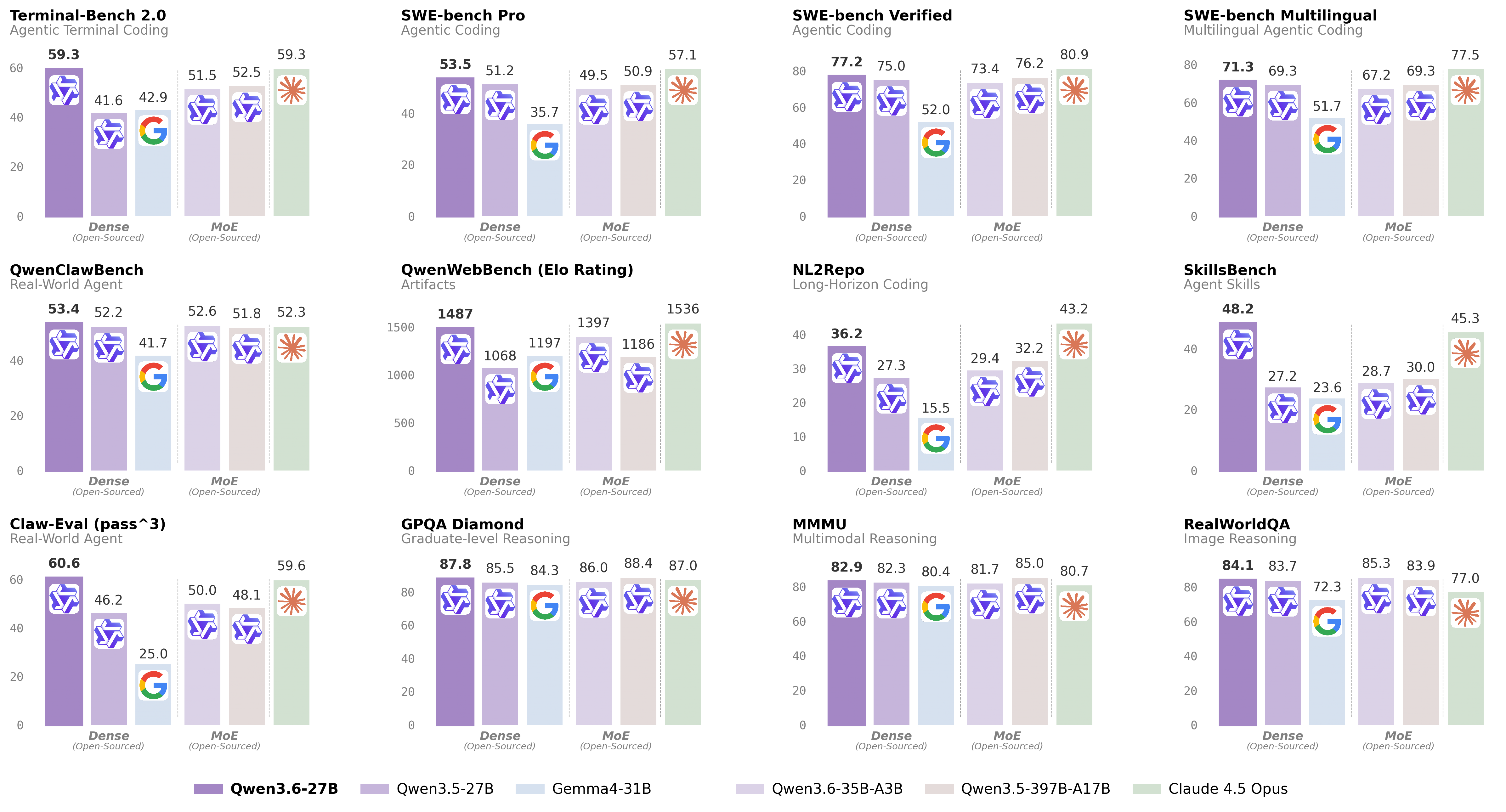
qwen3.6-40b-claude-4.6-opus-deckard-heretic-uncensored-thinking-neo-code-di-imatrix-max
The Qwen 3.5 version (also 40B) got 181 likes+ This version uses the new Qwen 3.6 27B arch (which exceeds even Qwen's own 398B model).
WARNING: This model has character and intelligence. It will take no prisoners. It will give no quarter. Uncensored,
Unfiltered and boldly confident. Not even remotely "SFW", if you ask it for NSFW content. And it is wickedly smart too - exceeding the base model in 6 out of 7 benchmarks.
Qwen3.6-40B-Claude-4.6-Opus-Deckard-Heretic-Uncensored-Thinking
40 billion parameters (dense, not moe) expanded from 27B Qwen 3.6, then trained on Claude 4.6 Opus High Reasoning dataset via Unsloth on local hardware... but there
is much more to the story - in comes DECKARD.
96 layers, 1275 Tensors. (50% more than base model of 27B)
Features variable length reasoning ; less complex = shorter, longer for more complex.
Model performance has increased dramatically. And it has character too.
A lot of character.
No censorship, no nanny. (via Heretic)
And it is very, very smart.
...
Repository: localaiLicense: apache-2.0
qwen3.6-27b-heretic-uncensored-finetune-neo-code-di-imatrix-max
Qwen3.6-27B-Heretic2-Uncensored-Finetune-Thinking
Yes... fully uncensored AND fine tuned lightly.
Freedom and brainpower.
Trained on different Heretic base, with different KLD/Refusals.
Model fine tune was used to finalize and "firm up" Heretic / uncensored changes.
The goal here was light, minor fixes rather than full / heavy fine tune.
That being said, the tuning still raised critical metrics.
This is Version 2, using "trohrbaugh" Heretic, which has a lower refusal rate, and tuning bumped up the metrics a bit more too.
This has also positively impacted "NEO-Coder Di-Matrix" (dual imatrix) GGUF quants as well (vs heretic/non heretic too).
https://huggingface.co/DavidAU/Qwen3.6-27B-Heretic-Uncensored-FINETUNE-NEO-CODE-Di-IMatrix-MAX-GGUF
```
IN HOUSE BENCHMARKS [by Nightmedia]:
arc-c arc/e boolq hswag obkqa piqa wino
Qwen3.6-27B-Heretic2-Uncensored-Finetune-Thinking
mxfp8 0.673,0.846,0.905... [instruct mode]
Qwen3.6-27B-Heretic-Uncensored-Finetune-Thinking
mxfp8 0.669,0.835,0.906,... [instruct mode]
BASE UNTUNED MODEL:
Qwen3.6-27B HERETIC (by llmfan46) [instruct mode]
mxfp8 0.644,0.788,0.902,...
...
Repository: localaiLicense: apache-2.0
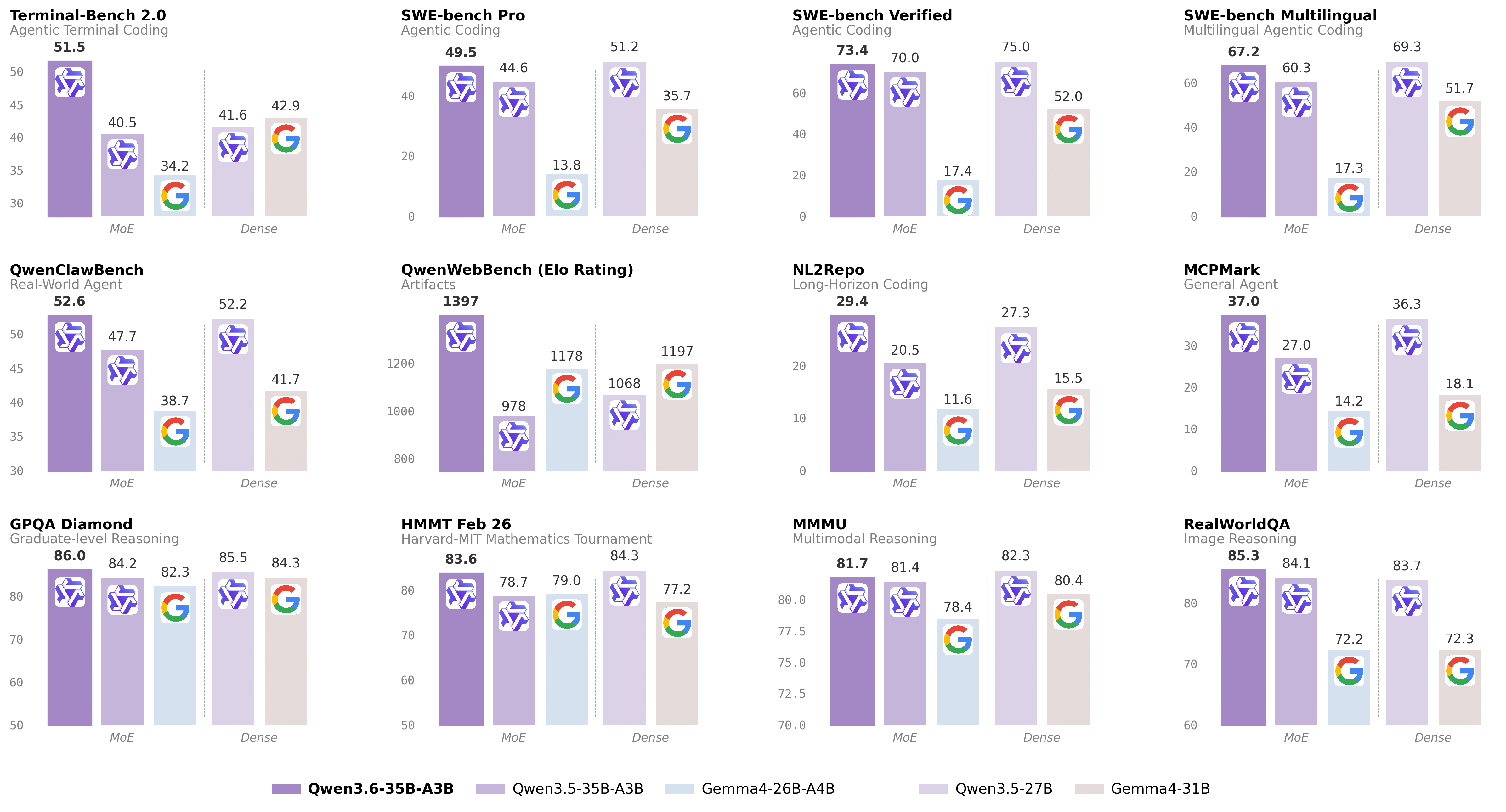
qwen3.6-35b-a3b-claude-4.6-opus-reasoning-distilled
# 🔥 Qwen3.6-35B-A3B-Claude-4.6-Opus-Reasoning-Distilled
A reasoning SFT fine-tune of `Qwen/Qwen3.6-35B-A3B` on chain-of-thought (CoT) distillation mostly sourced from Claude Opus 4.6. The goal is to preserve Qwen3.6's strong agentic coding and reasoning base while nudging the model toward structured Claude Opus-style reasoning traces and more stable long-form problem solving.
The training path is text-only. The Qwen3.6 base architecture includes a vision encoder, but this fine-tuning run did not train on image or video examples.
- **Developed by:** @hesamation
- **Base model:** `Qwen/Qwen3.6-35B-A3B`
- **License:** apache-2.0
This fine-tuning run is inspired by Jackrong/Qwen3.5-27B-Claude-4.6-Opus-Reasoning-Distilled, including the notebook/training workflow style and Claude Opus reasoning-distillation direction.
[](https://x.com/Hesamation) [](https://discord.gg/vtJykN3t)
## Benchmark Results
The MMLU-Pro pass used 70 total questions per model: `--limit 5` across 14 MMLU-Pro subjects. Treat this as a smoke/comparative check, not a release-quality full benchmark.
...
Repository: localaiLicense: apache-2.0

qwen3.5-397b-a17b
Repository: localaiLicense: apache-2.0

nanbeige4.1-3b-q4
Nanbeige4.1-3B is built upon Nanbeige4-3B-Base and represents an enhanced iteration of our previous reasoning model, Nanbeige4-3B-Thinking-2511, achieved through further post-training optimization with supervised fine-tuning (SFT) and reinforcement learning (RL). As a highly competitive open-source model at a small parameter scale, Nanbeige4.1-3B illustrates that compact models can simultaneously achieve robust reasoning, preference alignment, and effective agentic behaviors.
Key features:
Strong Reasoning: Capable of solving complex, multi-step problems through sustained and coherent reasoning within a single forward pass, reliably producing correct answers on benchmarks like LiveCodeBench-Pro, IMO-Answer-Bench, and AIME 2026 I.
Robust Preference Alignment: Outperforms same-scale models (e.g., Qwen3-4B-2507, Nanbeige4-3B-2511) and larger models (e.g., Qwen3-30B-A3B, Qwen3-32B) on Arena-Hard-v2 and Multi-Challenge.
Agentic Capability: First general small model to natively support deep-search tasks and sustain complex problem-solving with >500 rounds of tool invocations; excels in benchmarks like xBench-DeepSearch (75), Browse-Comp (39), and others.
Repository: localaiLicense: apache-2.0

acestep-cpp-turbo
ACE-Step 1.5 Turbo (C++ / GGML) — native C++ music generation from text descriptions and lyrics.
Two-stage pipeline: text-to-code (Qwen3 LM) + code-to-audio (DiT-VAE). Stereo 48kHz output.
Uses Q8_0 quantized models for a good balance of quality and speed.
Repository: localaiLicense: mit
acestep-cpp-turbo-4b
ACE-Step 1.5 Turbo (C++ / GGML) with 4B LM — higher quality music generation from text and lyrics.
Uses the larger 4B parameter LM for better metadata/code generation. Stereo 48kHz output.
Repository: localaiLicense: mit
Page 1