Model Gallery

74 models from 1 repositories

Filter by type:

Filter by tags:

qwen-agentworld-35b-a3b
# Qwen-AgentWorld-35B-A3B 📑 Technical Report | 📖 Blog | 🤗 Hugging Face | 🤖 ModelScope | 💻 GitHub | 🖥️ Demo > [!Note] > This repository contains the model weights and configuration files for **Qwen-AgentWorld-35B-A3B**, a native language world model trained for agentic environment simulation. > > These artifacts are compatible with Hugging Face Transformers, vLLM, SGLang, etc. **Qwen-AgentWorld** is the first language world model to cover seven agent interaction domains within a single model. It simulates agentic environments via long chain-of-thought reasoning, predicting the next environment state given an agent's action and interaction history. Trained through a three-stage pipeline — CPT injects environment knowledge, SFT activates next-state-prediction reasoning, RL sharpens simulation fidelity — Qwen-AgentWorld is a **native world model**: environment modeling is the training objective from the CPT stage onward, not a post-hoc add-on. ## Highlights ...

Repository: localaiLicense: apache-2.0

ornith-1.0-9b
[](https://deep-reinforce.com/ornith.html) # Ornith-1.0-9B-GGUF Aloha! 🌺 Today, we are releasing Ornith-1.0, a self-improving family of open-source models for agentic coding. Highlights: - **State-of-the-Art Coding Agents**: Available in 9B-Dense, 31B-Dense, 35B-MoE, and 397B-MoE (post-trained on top of Gemma 4 and Qwen 3.5), achieving state-of-the-art performance among open-source models of comparable size on coding benchmarks such as Terminal-Bench 2.1, SWE-Bench, NL2Repo and OpenClaw. - **Self-Improving Training Framework**:  Ornith-1.0 employs RL to learn to generate not only solution rollouts, but also the scallfold that drive those rollouts. By jointly optimizing the scaffold and the resulting solution, the model discovers better search trajectories and generates higher-quality solutions. - **Licence**: MIT licensed, globally accessible, and free from regional limitations. ## Ornith 1.0 9B This model card documents **Ornith-1.0-9B**, the most lightweight member of the Ornith family, designed for efficient single-GPU deployment. ### Benchmarks Ornith-1.0-9B Qwen3.5-9B Qwen3.5-35B Gemma4-12B Gemma4-31B Agentic Coding ...

Repository: localaiLicense: mit

ornith-1.0-35b
[](https://deep-reinforce.com/ornith.html) # Ornith-1.0-35B-GGUF Aloha! 🌺 Today, we are releasing Ornith-1.0, a self-improving family of open-source models for agentic coding. Highlights: - **State-of-the-Art Coding Agents**: Available in 9B-Dense, 31B-Dense, 35B-MoE, and 397B-MoE (post-trained on top of Gemma 4 and Qwen 3.5), achieving state-of-the-art performance among open-source models of comparable size on coding benchmarks such as Terminal-Bench 2.1, SWE-Bench, NL2Repo and OpenClaw. - **Self-Improving Training Framework**: Ornith-1.0 employs RL to learn to generate not only solution rollouts, but also the scallfold that drive those rollouts. By jointly optimizing the scaffold and the resulting solution, the model discovers better search trajectories and generates higher-quality solutions. - **Licence**: MIT licensed, globally accessible, and free from regional limitations. ## Ornith 1.0 35B This model card documents **Ornith-1.0-35B**, the lightweight member of the Ornith family, designed for efficient single-GPU deployment. ### Benchmarks Ornith-1.0-35B Qwen3.5-35B Qwen3.6-35B Gemma4-31B Qwen3.5-397B Agentic Coding ...

Repository: localaiLicense: mit

qwopus3.6-27b-coder-compat-mtp
🪐 Qwopus-3.6-27B-Coder Coder SFT Release Agentic Coding & Tool-Use Reasoning Model Fine-Tuned on Qwopus3.6-27B-v2 🧬 Trace Inversion & Negentropy 🧠 27B Dense Model ⚡ Agentic Coding 🛠️ Tool Calling & Agent 🏆 SWE-bench Verified: 67.0% (off-thinking) 💡 What is Qwopus-3.6-27B-Coder? 🪐 Qwopus-3.6-27B-Coder is a reasoning-enhanced agentic coding model built on top of Qwopus3.6-27B-v2. It inherits the powerful reasoning foundation of the v2 base — which achieved 87.43% MMLU-Pro and 75.25% SWE-bench Verified — and further specializes it for agentic code generation, structured tool calling, debugging, and instruction-following in developer workflows. The model is designed to excel at repository-level coding tasks, multi-turn tool orchestration, and complex logical reasoning under realistic agent environments. 🧩 Agentic Coding Optimized for repository-level coding, debugging, patch generation, and structured multi-step development workflows. 🛠️ Tool Calling Learns from real agent trajectories with tool definitions, tool calls, and environment feedback for robust multi-turn execution. ...

Repository: localaiLicense: apache-2.0

kimi-k2.7-code
## 1. Model Introduction Kimi K2.7 Code is a coding-focused agentic model built upon Kimi K2.6. With substantial improvements on real-world long-horizon coding tasks, it strengthens end-to-end task completion across complex software engineering workflows while improving token efficiency, reducing thinking-token usage by approximately 30% compared with Kimi K2.6. ## 2. Model Summary ## 3. Evaluation Results Benchmark Kimi K2.6 Kimi K2.7 Code GPT-5.5 Claude Opus 4.8 Coding Kimi Code Bench v2 50.9 62.0 69.0 67.4 Program Bench 48.3 53.6 69.1 63.8 MLS Bench Lite 26.7 35.1 35.5 42.8 Agentic Kimi Claw 24/7 Bench 42.9 46.9 52.8 50.4 MCP Atlas 69.4 76.0 79.4 81.3 MCP Mark Verified 72.8 81.1 92.9 76.4 Footnotes ...

Repository: localaiLicense: other

qwopus3.6-27b-coder-mtp-nvfp4
🪐 Qwopus-3.6-27B-Coder Coder SFT Release Agentic Coding & Tool-Use Reasoning Model Fine-Tuned on Qwopus3.6-27B-v2 🧬 Trace Inversion & Negentropy 🧠 27B Dense Model ⚡ Agentic Coding 🛠️ Tool Calling & Agent 🏆 SWE-bench Verified: 67.0% (off-thinking) 💡 What is Qwopus-3.6-27B-Coder? 🪐 Qwopus-3.6-27B-Coder is a reasoning-enhanced agentic coding model built on top of Qwopus3.6-27B-v2. It inherits the powerful reasoning foundation of the v2 base — which achieved 87.43% MMLU-Pro (300ex) and 75.25% SWE-bench Verified — and further specializes it for agentic code generation, structured tool calling, debugging, and instruction-following in developer workflows. The model is designed to excel at repository-level coding tasks, multi-turn tool orchestration, and complex logical reasoning under realistic agent environments. 🧩 Agentic Coding Optimized for repository-level coding, debugging, patch generation, and structured multi-step development workflows. 🛠️ Tool Calling Learns from real agent trajectories with tool definitions, tool calls, and environment feedback for robust multi-turn execution. ...

Repository: localai

gemma-4-12b-agentic-fable5-composer2.5-v2-3.5x-tau2
Hugging Face | GitHub | Launch Blog | Documentation License: Apache 2.0 | Authors: Google DeepMind > [!Note] > This model card is for the Gemma 4 12B Unified model, which is part of the Gemma 4 family of open models. Built with the same multimodal functionality as Gemma 4 E2B and E4B (text, audio, image, and video inputs), it brings native audio and vision understanding directly to local environments without the need for separate encoders. This unified approach to multimodality makes the model encoder-free, offering a deployment size that is perfect for consumer devices and streamlined local execution. Gemma is a family of open models built by Google DeepMind. Gemma 4 models are multimodal, handling text and image input (with audio supported on E2B, E4B, and 12B) and generating text output. This release includes open-weights models in both pre-trained and instruction-tuned variants. Gemma 4 features a context window of up to 256K tokens and maintains multilingual support in over 140 languages. ...

Repository: localaiLicense: apache-2.0

step-3.7-flash
**[ModelPage]**: https://static.stepfun.com/blog/step-3.7-flash/ ## 1. Introduction Step 3.7 Flash is a 198B-parameter sparse Mixture-of-Experts (MoE) vision-language model that combines a 196B-parameter language backbone with a 1.8B-parameter vision encoder for native image understanding. Engineered for high-frequency production workloads, it activates approximately 11B parameters per token and delivers a throughput of up to 400 tokens per second. Step 3.7 Flash supports a 256k context window and offers three selectable reasoning levels (low, medium, and high) so developers can easily balance speed, cost, and cognitive depth. We built Step 3.7 Flash for developers who need to scale agentic workflows that combine perception, search, and reasoning. It is designed to handle intensive tasks such as parsing massive financial reports in one pass, running multi-step search loops with cross-source verification, or operating concurrent coding agents in high-throughput pipelines. ## 2. Capabilities & Performance ### Multimodal Perception and Verification ...

Repository: localaiLicense: apache-2.0

lfm2.5-8b-a1b
Try LFM • Docs • LEAP • Discord # LFM2.5-8B-A1B LFM2.5 is a new family of hybrid models designed for on-device deployment. It builds on the LFM2 architecture with extended pre-training and reinforcement learning. - **On-device personal assistant**: Designed to power real-life applications, chaining tool calls, and following complex instructions on all devices. - **Compressed performance**: Competitive with much larger dense and MoE models on instruction following and agentic tasks. - **Unmatched throughput**: Fastest in its size class on both CPU and GPU inference, with day-one support for llama.cpp, MLX, vLLM, and SGLang. Find more information about LFM2.5-8B-A1B in our blog post. **AA-Omniscience Index (higher is better) rewards correct answers and penalizes hallucinations. Scores range from -100 to 100. See more results on Artificial Analysis.* ## 🗒️ Model Details LFM2.5-8B-A1B is a general-purpose text-only model with the following features: ...

Repository: localaiLicense: other

qwopus3.5-9b-coder-mtp
# 🌟 Qwopus3.5-9B-v3.5 ## 💡 Model Overview & v3.5 Design Qwopus3.5-9B-v3.5 is a **data-scaled continuation** of the Qwopus3.5-9B-v3 model. The training data in v3.5 is expanded to cover a broader range of domains, including mathematics, programming, puzzle-solving, multilingual dialogue, instruction-following, multi-turn interactions, and STEM-related tasks. Qwopus3.5-9B-v3.5 is a reasoning-enhanced model based on **Qwen3.5-9B**, designed for: - 🧩 Structured reasoning - 🔧 Tool-augmented workflows - 🔁 Multi-step agentic tasks - ⚡ Token-efficient inference Compared with Qwopus3.5-9B-v3, **3.5 version does not introduce a new architecture, RL stage, or template redesign**. This version is trained with approximately **2× more SFT data**. ## 🎯 Motivation & Generalization Insight The motivation behind v3.5 comes from a simple observation: > This work is motivated by the hypothesis that scaling high-quality SFT data may further enhance the generalization ability of large language models. In earlier Qwopus3.5 experiments, structured reasoning was observed to improve both **accuracy and efficiency**: ...

Repository: localaiLicense: apache-2.0

kimi-k2.6
🤗  huggingchat  |  📰  Tech Blog ## 1. Model Introduction Kimi K2.6 is an open-source, native multimodal agentic model that advances practical capabilities in long-horizon coding, coding-driven design, proactive autonomous execution, and swarm-based task orchestration. ### Key Features - **Long-Horizon Coding**: K2.6 achieves significant improvements on complex, end-to-end coding tasks, generalizing robustly across programming languages (Rust, Go, Python) and domains spanning front-end, DevOps, and performance optimization. - **Coding-Driven Design**: K2.6 is capable of transforming simple prompts and visual inputs into production-ready interfaces and lightweight full-stack workflows, generating structured layouts, interactive elements, and rich animations with deliberate aesthetic precision. - **Elevated Agent Swarm**: Scaling horizontally to 300 sub-agents executing 4,000 coordinated steps, K2.6 can dynamically decompose tasks into parallel, domain-specialized subtasks, delivering end-to-end outputs from documents to websites to spreadsheets in a single autonomous run. - **Proactive & Open Orchestration**: For autonomous tasks, K2.6 demonstra ...

Repository: localaiLicense: modified-mit
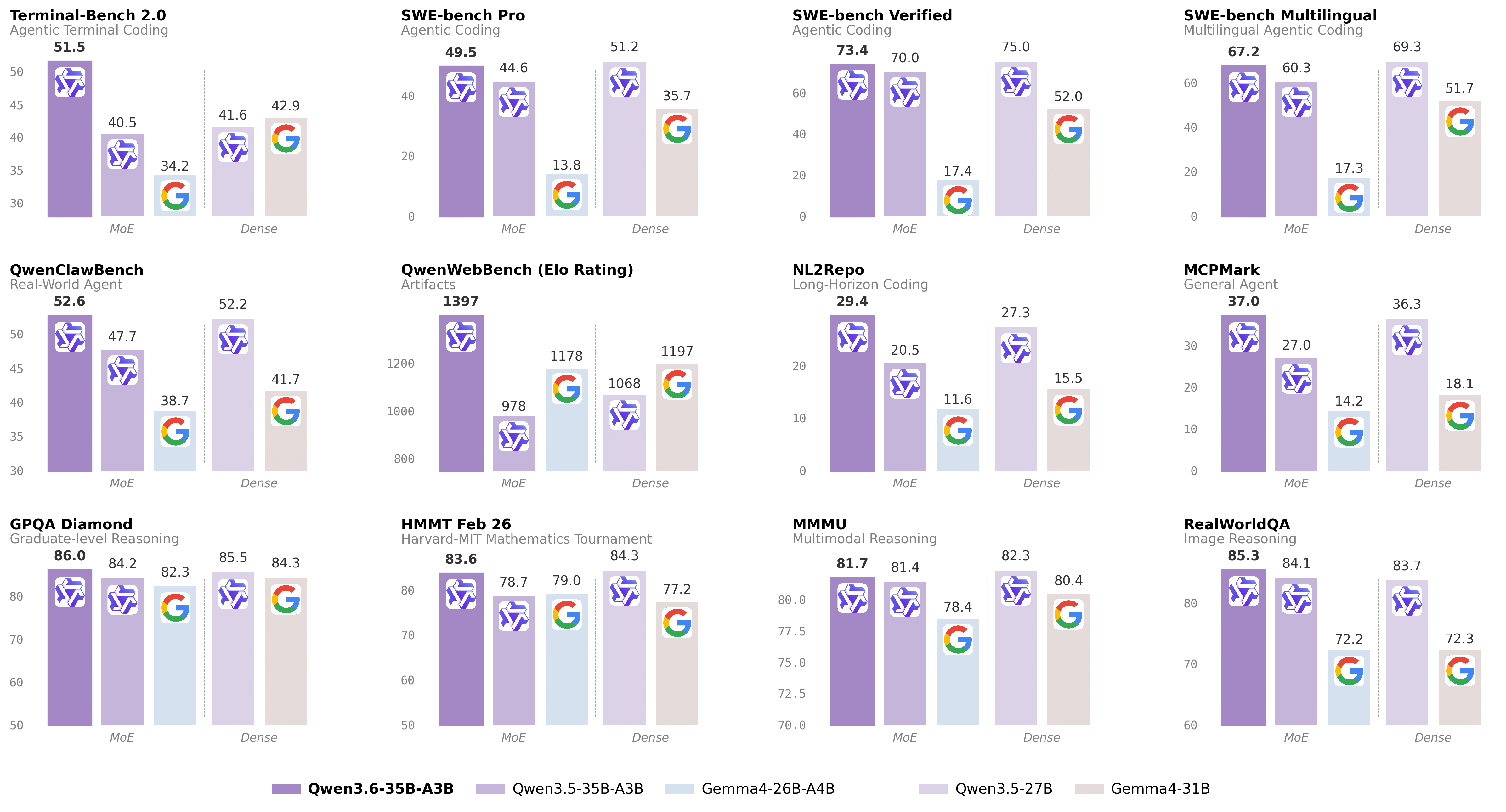
qwen3.6-35b-a3b-claude-4.6-opus-reasoning-distilled
# 🔥 Qwen3.6-35B-A3B-Claude-4.6-Opus-Reasoning-Distilled A reasoning SFT fine-tune of `Qwen/Qwen3.6-35B-A3B` on chain-of-thought (CoT) distillation mostly sourced from Claude Opus 4.6. The goal is to preserve Qwen3.6's strong agentic coding and reasoning base while nudging the model toward structured Claude Opus-style reasoning traces and more stable long-form problem solving. The training path is text-only. The Qwen3.6 base architecture includes a vision encoder, but this fine-tuning run did not train on image or video examples. - **Developed by:** @hesamation - **Base model:** `Qwen/Qwen3.6-35B-A3B` - **License:** apache-2.0 This fine-tuning run is inspired by Jackrong/Qwen3.5-27B-Claude-4.6-Opus-Reasoning-Distilled, including the notebook/training workflow style and Claude Opus reasoning-distillation direction. [](https://x.com/Hesamation) [](https://discord.gg/vtJykN3t) ## Benchmark Results The MMLU-Pro pass used 70 total questions per model: `--limit 5` across 14 MMLU-Pro subjects. Treat this as a smoke/comparative check, not a release-quality full benchmark. ...

Repository: localaiLicense: apache-2.0

nanbeige4.1-3b-q8
Nanbeige4.1-3B is built upon Nanbeige4-3B-Base and represents an enhanced iteration of our previous reasoning model, Nanbeige4-3B-Thinking-2511, achieved through further post-training optimization with supervised fine-tuning (SFT) and reinforcement learning (RL). As a highly competitive open-source model at a small parameter scale, Nanbeige4.1-3B illustrates that compact models can simultaneously achieve robust reasoning, preference alignment, and effective agentic behaviors. Key features: Strong Reasoning: Capable of solving complex, multi-step problems through sustained and coherent reasoning within a single forward pass, reliably producing correct answers on benchmarks like LiveCodeBench-Pro, IMO-Answer-Bench, and AIME 2026 I. Robust Preference Alignment: Outperforms same-scale models (e.g., Qwen3-4B-2507, Nanbeige4-3B-2511) and larger models (e.g., Qwen3-30B-A3B, Qwen3-32B) on Arena-Hard-v2 and Multi-Challenge. Agentic Capability: First general small model to natively support deep-search tasks and sustain complex problem-solving with >500 rounds of tool invocations; excels in benchmarks like xBench-DeepSearch (75), Browse-Comp (39), and others.

Repository: localaiLicense: apache-2.0

nanbeige4.1-3b-q4
Nanbeige4.1-3B is built upon Nanbeige4-3B-Base and represents an enhanced iteration of our previous reasoning model, Nanbeige4-3B-Thinking-2511, achieved through further post-training optimization with supervised fine-tuning (SFT) and reinforcement learning (RL). As a highly competitive open-source model at a small parameter scale, Nanbeige4.1-3B illustrates that compact models can simultaneously achieve robust reasoning, preference alignment, and effective agentic behaviors. Key features: Strong Reasoning: Capable of solving complex, multi-step problems through sustained and coherent reasoning within a single forward pass, reliably producing correct answers on benchmarks like LiveCodeBench-Pro, IMO-Answer-Bench, and AIME 2026 I. Robust Preference Alignment: Outperforms same-scale models (e.g., Qwen3-4B-2507, Nanbeige4-3B-2511) and larger models (e.g., Qwen3-30B-A3B, Qwen3-32B) on Arena-Hard-v2 and Multi-Challenge. Agentic Capability: First general small model to natively support deep-search tasks and sustain complex problem-solving with >500 rounds of tool invocations; excels in benchmarks like xBench-DeepSearch (75), Browse-Comp (39), and others.

Repository: localaiLicense: apache-2.0

opengvlab_internvl3_5-30b-a3b
We introduce InternVL3.5, a new family of open-source multimodal models that significantly advances versatility, reasoning capability, and inference efficiency along the InternVL series. A key innovation is the Cascade Reinforcement Learning (Cascade RL) framework, which enhances reasoning through a two-stage process: offline RL for stable convergence and online RL for refined alignment. This coarse-to-fine training strategy leads to substantial improvements on downstream reasoning tasks, e.g., MMMU and MathVista. To optimize efficiency, we propose a Visual Resolution Router (ViR) that dynamically adjusts the resolution of visual tokens without compromising performance. Coupled with ViR, our Decoupled Vision-Language Deployment (DvD) strategy separates the vision encoder and language model across different GPUs, effectively balancing computational load. These contributions collectively enable InternVL3.5 to achieve up to a +16.0% gain in overall reasoning performance and a 4.05 ×\times× inference speedup compared to its predecessor, i.e., InternVL3. In addition, InternVL3.5 supports novel capabilities such as GUI interaction and embodied agency. Notably, our largest model, i.e., InternVL3.5-241B-A28B, attains state-of-the-art results among open-source MLLMs across general multimodal, reasoning, text, and agentic tasks—narrowing the performance gap with leading commercial models like GPT-5. All models and code are publicly released.

Repository: localaiLicense: apache-2.0

opengvlab_internvl3_5-30b-a3b-q8_0
We introduce InternVL3.5, a new family of open-source multimodal models that significantly advances versatility, reasoning capability, and inference efficiency along the InternVL series. A key innovation is the Cascade Reinforcement Learning (Cascade RL) framework, which enhances reasoning through a two-stage process: offline RL for stable convergence and online RL for refined alignment. This coarse-to-fine training strategy leads to substantial improvements on downstream reasoning tasks, e.g., MMMU and MathVista. To optimize efficiency, we propose a Visual Resolution Router (ViR) that dynamically adjusts the resolution of visual tokens without compromising performance. Coupled with ViR, our Decoupled Vision-Language Deployment (DvD) strategy separates the vision encoder and language model across different GPUs, effectively balancing computational load. These contributions collectively enable InternVL3.5 to achieve up to a +16.0% gain in overall reasoning performance and a 4.05 ×\times× inference speedup compared to its predecessor, i.e., InternVL3. In addition, InternVL3.5 supports novel capabilities such as GUI interaction and embodied agency. Notably, our largest model, i.e., InternVL3.5-241B-A28B, attains state-of-the-art results among open-source MLLMs across general multimodal, reasoning, text, and agentic tasks—narrowing the performance gap with leading commercial models like GPT-5. All models and code are publicly released.

Repository: localaiLicense: apache-2.0

opengvlab_internvl3_5-14b-q8_0
We introduce InternVL3.5, a new family of open-source multimodal models that significantly advances versatility, reasoning capability, and inference efficiency along the InternVL series. A key innovation is the Cascade Reinforcement Learning (Cascade RL) framework, which enhances reasoning through a two-stage process: offline RL for stable convergence and online RL for refined alignment. This coarse-to-fine training strategy leads to substantial improvements on downstream reasoning tasks, e.g., MMMU and MathVista. To optimize efficiency, we propose a Visual Resolution Router (ViR) that dynamically adjusts the resolution of visual tokens without compromising performance. Coupled with ViR, our Decoupled Vision-Language Deployment (DvD) strategy separates the vision encoder and language model across different GPUs, effectively balancing computational load. These contributions collectively enable InternVL3.5 to achieve up to a +16.0% gain in overall reasoning performance and a 4.05 ×\times× inference speedup compared to its predecessor, i.e., InternVL3. In addition, InternVL3.5 supports novel capabilities such as GUI interaction and embodied agency. Notably, our largest model, i.e., InternVL3.5-241B-A28B, attains state-of-the-art results among open-source MLLMs across general multimodal, reasoning, text, and agentic tasks—narrowing the performance gap with leading commercial models like GPT-5. All models and code are publicly released.

Repository: localaiLicense: apache-2.0

opengvlab_internvl3_5-14b
We introduce InternVL3.5, a new family of open-source multimodal models that significantly advances versatility, reasoning capability, and inference efficiency along the InternVL series. A key innovation is the Cascade Reinforcement Learning (Cascade RL) framework, which enhances reasoning through a two-stage process: offline RL for stable convergence and online RL for refined alignment. This coarse-to-fine training strategy leads to substantial improvements on downstream reasoning tasks, e.g., MMMU and MathVista. To optimize efficiency, we propose a Visual Resolution Router (ViR) that dynamically adjusts the resolution of visual tokens without compromising performance. Coupled with ViR, our Decoupled Vision-Language Deployment (DvD) strategy separates the vision encoder and language model across different GPUs, effectively balancing computational load. These contributions collectively enable InternVL3.5 to achieve up to a +16.0% gain in overall reasoning performance and a 4.05 ×\times× inference speedup compared to its predecessor, i.e., InternVL3. In addition, InternVL3.5 supports novel capabilities such as GUI interaction and embodied agency. Notably, our largest model, i.e., InternVL3.5-241B-A28B, attains state-of-the-art results among open-source MLLMs across general multimodal, reasoning, text, and agentic tasks—narrowing the performance gap with leading commercial models like GPT-5. All models and code are publicly released.

Repository: localaiLicense: apache-2.0

opengvlab_internvl3_5-8b
We introduce InternVL3.5, a new family of open-source multimodal models that significantly advances versatility, reasoning capability, and inference efficiency along the InternVL series. A key innovation is the Cascade Reinforcement Learning (Cascade RL) framework, which enhances reasoning through a two-stage process: offline RL for stable convergence and online RL for refined alignment. This coarse-to-fine training strategy leads to substantial improvements on downstream reasoning tasks, e.g., MMMU and MathVista. To optimize efficiency, we propose a Visual Resolution Router (ViR) that dynamically adjusts the resolution of visual tokens without compromising performance. Coupled with ViR, our Decoupled Vision-Language Deployment (DvD) strategy separates the vision encoder and language model across different GPUs, effectively balancing computational load. These contributions collectively enable InternVL3.5 to achieve up to a +16.0% gain in overall reasoning performance and a 4.05 ×\times× inference speedup compared to its predecessor, i.e., InternVL3. In addition, InternVL3.5 supports novel capabilities such as GUI interaction and embodied agency. Notably, our largest model, i.e., InternVL3.5-241B-A28B, attains state-of-the-art results among open-source MLLMs across general multimodal, reasoning, text, and agentic tasks—narrowing the performance gap with leading commercial models like GPT-5. All models and code are publicly released.

Repository: localaiLicense: apache-2.0

opengvlab_internvl3_5-8b-q8_0
We introduce InternVL3.5, a new family of open-source multimodal models that significantly advances versatility, reasoning capability, and inference efficiency along the InternVL series. A key innovation is the Cascade Reinforcement Learning (Cascade RL) framework, which enhances reasoning through a two-stage process: offline RL for stable convergence and online RL for refined alignment. This coarse-to-fine training strategy leads to substantial improvements on downstream reasoning tasks, e.g., MMMU and MathVista. To optimize efficiency, we propose a Visual Resolution Router (ViR) that dynamically adjusts the resolution of visual tokens without compromising performance. Coupled with ViR, our Decoupled Vision-Language Deployment (DvD) strategy separates the vision encoder and language model across different GPUs, effectively balancing computational load. These contributions collectively enable InternVL3.5 to achieve up to a +16.0% gain in overall reasoning performance and a 4.05 ×\times× inference speedup compared to its predecessor, i.e., InternVL3. In addition, InternVL3.5 supports novel capabilities such as GUI interaction and embodied agency. Notably, our largest model, i.e., InternVL3.5-241B-A28B, attains state-of-the-art results among open-source MLLMs across general multimodal, reasoning, text, and agentic tasks—narrowing the performance gap with leading commercial models like GPT-5. All models and code are publicly released.

Repository: localaiLicense: apache-2.0

opengvlab_internvl3_5-4b
We introduce InternVL3.5, a new family of open-source multimodal models that significantly advances versatility, reasoning capability, and inference efficiency along the InternVL series. A key innovation is the Cascade Reinforcement Learning (Cascade RL) framework, which enhances reasoning through a two-stage process: offline RL for stable convergence and online RL for refined alignment. This coarse-to-fine training strategy leads to substantial improvements on downstream reasoning tasks, e.g., MMMU and MathVista. To optimize efficiency, we propose a Visual Resolution Router (ViR) that dynamically adjusts the resolution of visual tokens without compromising performance. Coupled with ViR, our Decoupled Vision-Language Deployment (DvD) strategy separates the vision encoder and language model across different GPUs, effectively balancing computational load. These contributions collectively enable InternVL3.5 to achieve up to a +16.0% gain in overall reasoning performance and a 4.05 ×\times× inference speedup compared to its predecessor, i.e., InternVL3. In addition, InternVL3.5 supports novel capabilities such as GUI interaction and embodied agency. Notably, our largest model, i.e., InternVL3.5-241B-A28B, attains state-of-the-art results among open-source MLLMs across general multimodal, reasoning, text, and agentic tasks—narrowing the performance gap with leading commercial models like GPT-5. All models and code are publicly released.

Repository: localaiLicense: apache-2.0

Page 1